Wednesday, May 8, 2013

Splish Splash through the wheat field. Trying to beat the rain again!

Many people ask why farmers use pesticides and fungicides.  We apply herbicides to wheat to kill weeds that could alter the taste of milled flour such as wild onions.  Pesticides control aphids, stinkbugs, army worms and other bugs that can greatly degrade the quality of the grain as well.  We use these chemicals sparingly in order to grow milling quality wheat.  If we failed to manage our wheat crop accordingly you definitely wouldn't like the taste of your biscuit or bread.  Much of our wheat ends up at the Siemer Flour Mill in Hopkinsville, KY.  Siemer flour is found in McDonald's biscuits, Krusteaz brand products and Cheddar Biscuits at Red Lobster to name a few. 

Finally, some "Blue Skies" during a wet spring.  We are hurrying through the wheat to get it protected before the next rain event this weekend.

Timeliness is very important when making fungicide applications on wheat.  We try to hit it when 75-80% of the heads are fully emerged.  The fungicide protects the grain as it fills in the head so the test weight will be of milling quality. 

Wednesday, April 24, 2013

It all starts with a seed.


These aren't the seeds my grandfather planted 50 years ago.  Our seeds today are packed with improved genetics and technology.    All of our corn is Round Up Ready corn.  Geneticists have mapped the DNA of corn and figured out what naturally occuring genes in the corn allowed some corn to live after being sprayed with round up.  After this finding they were able to increase this naturally occuring gene by stimulating the part of the DNA to make all the plants resistant to round up in Round Up Ready varieities.  The benefit to Round Up Corn is we are able to use much less atrazine and other chemicals that when over used can end up in ground water.  Round Up Herbicide is very safe for the environment. 

The green kernels are BT corn and the Purple are Non BT "refuge" seeds.  These are mixed in at about 10% of the total mix so the beneficial insects have food to eat.  The BT corn is designed to increase the expression of naturally occuring plant chemicals to ward off pests like the corn borer and root worms that can have devestating effects on a corn crop with heavy infestation.  This self defense mechanism helps us reduce the amount of pesticides we have to apply on the corn crop, and allows us to select much less harmful chemistries for the environment, in the products we do have to apply to the crop.  
Our no-till planter is designed to disturb very little top soil.  The row sweeps clear a narrow path for the no-till coulter and double disc openers to put the corn in the ground.  This greatly reduces soil erosion and leaves the organic matter to hold water in the soil for the crop during the hot and dry summer months.


The corn is planted at about a 2 inch depth.  The boys love digging the seed up!
Spring time is a beautiful time on the farm.  As we plant the crops and watch them emerge in rows, the new growing season offers new life and hopes of a bountiful harvest for this year.

Friday, April 12, 2013

Long Days... Longer Nights

 
 The wet weather has pushed our work back this spring.  We have only had a few days here and there to get our work done.  We have all been putting in long days and nights applying anhydrous, spraying wheat and planting to get it all done.  Auto Steer on the equipment makes the long days much better. Hopefully the rain will continue to fall through the growing season. 


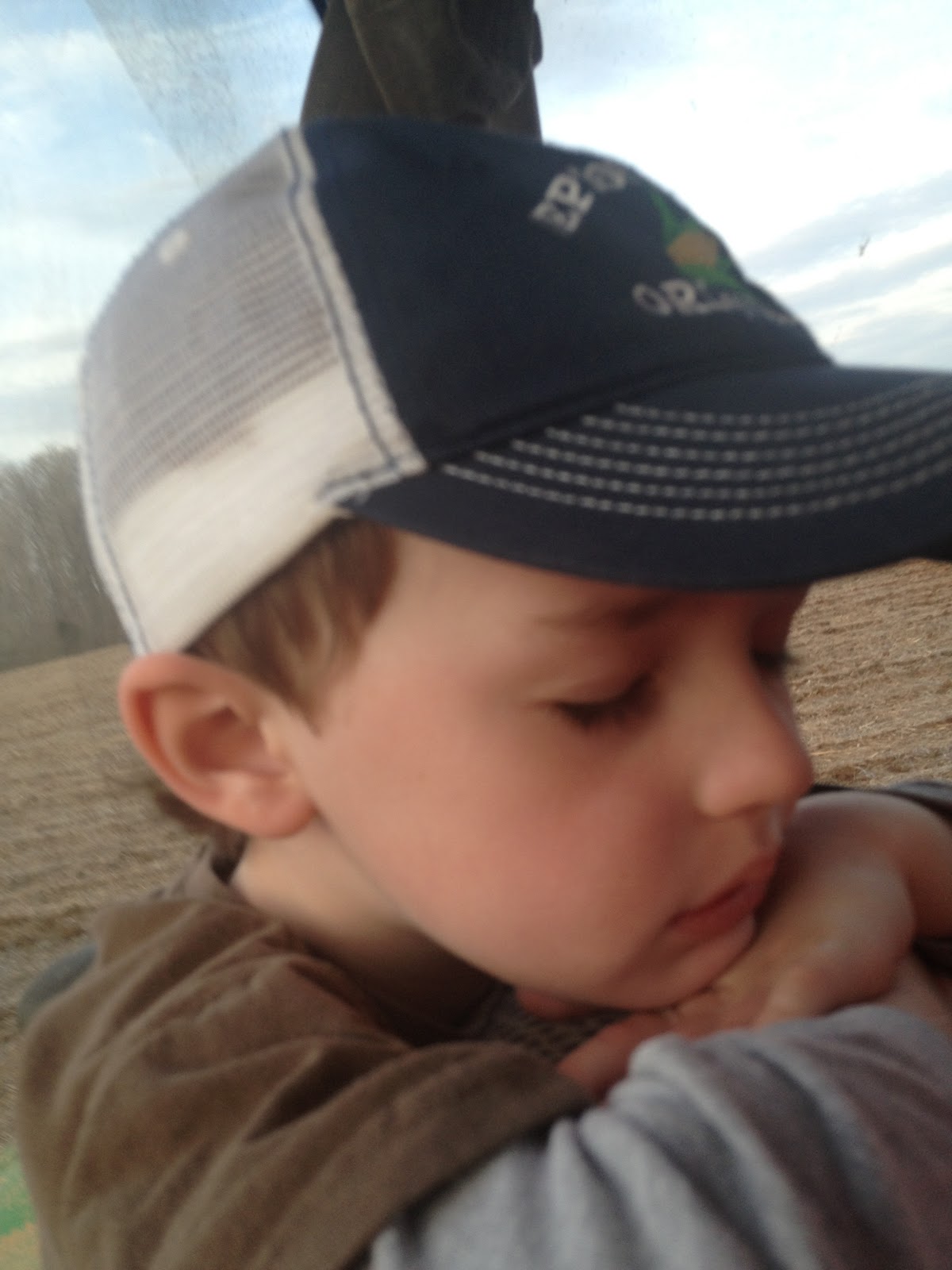
Even our little helpers are worn out!


Wednesday, March 27, 2013

http://magissues.farmprogress.com/MDS/MS04Apr13/mds001.pdf

I recently had the opportunity to visit with Cecil Yancey a freelance writer for Farm Progress Publications. He asked me what our land meant to my family?  As a Family Farmer that is a deep question. I spent my time as a young boy wandering in the woods and fishing in the ponds and rivers throughout the land our family owns and rents from neighbors.  I can remember from an early age my father and grandfather teaching me how precious the land is and how everything we do as farmers begins and ends in the land.  I was taught that we are only the caretakers of the soil that has been entrusted to us during our time on earth.  I quickly understood how the decisions we made daily on our farm could have positive or negative impacts on our bottom line and future generations of Jepson Family Farmers.

Not only were we tasked with improving our land, some of which has been in our family for over 200 years now, but friends and neighbors had entrusted their most valuable asset to our family.  My father told me to never treat any acre of rented ground different than if we owned it ourselves. He taught me   what it meant for others to put their faith in our abilities and stewardship of their soil.  Today I feel as connected to rented farms adjoining our farm as the land my family owns. I don't remember not farming many of our leased acres.  I have worked these fields, picked up rocks, cut and removed blown over trees, mended fences, and repaired barns on most of these farms just like we have done on our own land my whole life.

My high school ag teachers taught me we were the original environmentalists before it was considered  a social status or green lifestyle. I began to understand how our farm practices affected our environment as much or more than the crops in our fields. I began to appreciate how no-till helped reduce erosion and prevent loss of nitrogen, phosphorous and potash into surface and ground water.  Today we have technology to manage our inputs and soil fertility down to sub inch accuracy to care for the environment even more.  GMO crops have helped reduce pesticide and herbicide use greatly.

Cecil quoted one of my first blog posts in his article:  Our land holds our family together, bound with our past as it provides for our future.  I can honestly say the memories of  my past and hearing the story of how our family has worked in our community for 7 generations is a pleasant reminder of where I come from.  I hope my boys look back and recall that I taught them to appreciate and value the land in the same way my father and grand father did for me.  My boys are learning why we do the things we do.  Just today I had the opportunity to explain to our 5 year old about managing woodlands as he put it, "So the Little trees will have a chance to be big trees." The best part of my work today is teaching my boys and watching them roam the fields with their dogs just like I did when I was their age. That is what our land means to me.

http://magissues.farmprogress.com/MDS/MS04Apr13/mds001.pdf

Monday, March 18, 2013

Variable Rate Fertilizer Application

As do most things on the farm fertilizer applications start in the office.  We use historic yield data and soil maps to produce management zone fertility recommendations for each area of our fields based on the productivity of the soils.  This lets us maximize productivity without over applying in areas that are less productive.  This saves us money and reduces the amount of fertilizer that could end up in the water supply if left in the field not used.  We variable rate apply: Potash, Phosphate, Lime and Anhydrous Ammonia (nitrogen) on all our corn fields.   
By using no-till equipment we leave crop residue from the previous crop on top of the ground. This residue acts like a mulch to hold in water and keep the ground cooler during the summer heat. Most importantly it helps the ground absorb more water when it rains and slows runoff to prevent soil erosion. We are building organic matter in the soil and that encourages microbial activity and critters like earth worms to live in the soil. These micro organisms help keep the soil healthy and make soils more productive.

The pictures below show the rate control equipment in the tractor that accepts the prescriptions we generate for each zone in the fields.  The GPS receiver mounted on the tractor lets the controller know where it is in the field to tell the applicator how much to apply in each zone.  The colors represent the different management zones on the right.


Friday, March 8, 2013

Greenhouse and grain bins.


Mac helped finish in the control building at the grain bins and check  on the greenhouse we seeded this morning. 


Add caption


Saturday, March 2, 2013

With generous support from the community, Robertson Co. Young Farmers rasied over $6000 for the Jason W. Bracy Scholarship Fund!  The scholarship money will be awarded to a Robertson Co. graduating senior planning to major in Agriculture at the University of thier choice.  We are proud to be a part of this Farm Bureau group.  The community has been very helpful and generous in helping promote the future of Agriculture in Robertson County TN.  This year's t-shrts are still available for $15 or $25 for two.  Message me if you would like one!